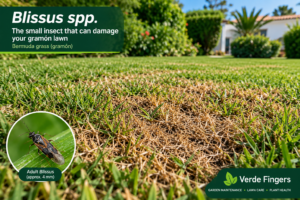
 Is your gramón or Bermuda grass turning brown even though you are watering it? One possible cause is Blissus spp., a small turf pest that can cause serious damage to lawns and grass areas.
 Is your gramón or Bermuda grass turning brown even though you are watering it? One possible cause is Blissus spp., a small turf pest that can cause serious damage to lawns and grass areas.
For homeowners and property managers in Andalucía, Cádiz and the Costa de la Luz, understanding how to identify Blissus early can help prevent extensive lawn damage.
At Verde Fingers, we provide professional garden and lawn maintenance services and can help investigate unexplained lawn deterioration.
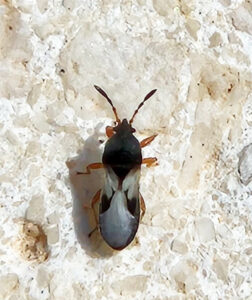 Blissus spp. are small sap-feeding insects belonging to the Blissidae family. They are sometimes referred to as chinch bugs.
These tiny insects feed on grass by piercing plant tissue and sucking out the plant’s fluids.
The result can be:
According to information published by Plagas Online, Blissus spp. have been identified as a pest of lawns and grasslands in the Iberian Peninsula, including warm-season grasses such as Bermuda grass.
Gramón (Bermuda grass) is extremely popular in southern Spain because it is well adapted to warm conditions.
It is commonly found in gardens, villas, holiday properties and landscaped areas throughout Andalucía.
However, warm-season turf can also provide suitable conditions for certain insect pests.
When Blissus populations become established, the insects can feed heavily on the grass.
The affected turf may gradually lose its green colour and develop areas that look as though they are suffering from drought.
This is one of the biggest challenges.
Imagine you have a gramón lawn in Cádiz during a hot summer.
You increase the irrigation.
You water more frequently.
But the brown patches continue to expand.
Before simply adding more water, it is worth investigating whether an insect pest such as Blissus could be involved.
Blissus damage can vary depending on the severity of the infestation and environmental conditions.
Typical symptoms may include:
1. Yellowing grass
Healthy green grass begins losing its colour.
2. Brown or straw-coloured patches
Sections of the lawn can become brown and appear severely stressed.
3. Irregular areas of damage
The affected areas may not follow the normal pattern of irrigation coverage.
4. Rapid deterioration
Damage can become increasingly obvious during hot weather.
5. Grass that doesn’t recover after watering
If adequate irrigation does not improve the affected area, another cause should be investigated.
Blissus and their young stages can be extremely difficult to see because of their small size.
They may be found around the base of grass plants, thatch and other protected areas.
The young nymphs are particularly small, which means an infestation can develop before the homeowner realises there is an insect problem.
This is why regular lawn inspection is important.
Warm conditions can encourage insect activity.
This is particularly relevant in southern Spain, where hot weather can persist for long periods.
Blissus populations can increase when conditions are favourable, potentially resulting in significant turf damage.
For lawns in Andalucía, regular monitoring during periods of warm weather can therefore be worthwhile.
One of the most common mistakes when dealing with brown grass is assuming:
“The lawn needs more water.”
Sometimes it does.
But brown grass can have many different causes.
For example:
That’s why correct diagnosis should come before treatment.
At Verde Fingers, we believe that treating the symptom without investigating the cause can waste time, money and products.
If you suspect Blissus, inspect the lawn carefully.
Look particularly closely at the transition between healthy green grass and damaged brown areas.
Examine the grass close to the soil surface and look for tiny insects or nymphs.
Because the insects are small, they can be difficult to identify without experience.
A professional inspection can help determine whether the problem is likely to be:
insect-related, disease-related, irrigation-related or soil-related.
There isn’t one solution for every lawn.
A healthy turf-management programme can include several measures.
Gramón needs water, particularly during periods of extreme heat.
However, increasing irrigation without identifying the cause of the damage isn’t always the answer.
Check that sprinklers are functioning correctly and that water is reaching the entire lawn evenly.
A thick layer of dead material between the grass and soil can create a difficult environment for healthy turf management.
Regular maintenance can help keep the lawn in better condition.
Compacted soil can restrict root development and reduce the lawn’s ability to absorb water and nutrients.
Aeration may be beneficial where compaction is a problem.
Good mowing practices, appropriate nutrition and correct irrigation all contribute to stronger turf.
A healthy lawn is better positioned to recover from environmental and pest-related stress.
Don’t wait until half the lawn has turned brown.
Regular inspection can help identify problems much earlier.
Sometimes, but professional treatment requires care.
There are plant-protection products containing insecticidal active ingredients that may have activity against turf pests.
However, in Spain, you should never assume that a product is legally authorised for use on a particular lawn simply because the active ingredient is known to control an insect.
The current MAPA authorisation and product label must be checked for the specific use, target pest, turf/crop situation, application rate and user requirements.
This is particularly important for professional gardeners working on clients’ properties.
If you are a professional gardener, the legal requirements surrounding plant-protection products are different from simply buying a garden product for personal use.
Before applying any plant-protection product professionally, the applicable Spanish requirements should be checked, including the product’s current authorisation and the qualifications or registration requirements applicable to the operator.
Never rely solely on information found on a gardening website, social media or an old product label.
Authorisations and labels can change.
The insect itself is not something that homeowners normally need to worry about in the same way as a biting or stinging pest.
However, any chemical lawn treatment needs to be assessed separately.
If a plant-protection product is used, the product label determines the required precautions, including any restrictions concerning people, pets, re-entry and treated areas.
At Verde Fingers, we believe that responsible lawn treatment means considering the people, pets, plants and environment around the lawn—not simply eliminating the pest.
If you have a gramón/Bermuda lawn in Cádiz province and are seeing unexplained brown patches, don’t automatically assume that the problem is lack of water.
A professional inspection can help identify the likely cause.
At Verde Fingers, we can assess the condition of your lawn as part of a wider garden-maintenance programme.
We look at the overall condition of the garden, including:
The aim is to identify the problem before recommending an appropriate course of action.
The earlier a turf problem is identified, the more opportunity there is to prevent widespread damage.
A small area of stressed grass can be much easier to investigate than an entire lawn that has already deteriorated.
If your gramón lawn is turning brown, don’t immediately increase the watering.
Check the irrigation.
Look at the grass.
Inspect the soil.
Look for signs of insects.
And consider whether Blissus could be responsible.
If your lawn in Chiclana, Cádiz or the surrounding Costa de la Luz area is developing unexplained brown patches, Verde Fingers can assess the condition of your garden and help identify possible causes.
Professional garden maintenance with a focus on healthy, well-maintained outdoor spaces.
Contact Verde Fingers to arrange a garden or lawn assessment.
Garden Maintenance | Lawn Care | Pest & Plant Health
Serving Chiclana de la Frontera, Cádiz and surrounding areas of Andalucía.
Blissus is a group of small sap-feeding insects in the Blissidae family that can damage turf grasses by feeding on the plants.
Yes. Bermuda grass, commonly known as gramón, is among the turf grasses that can be affected by Blissus.
Brown gramón can have many causes, including drought, irrigation problems, disease, soil problems and insect pests such as Blissus. Correct identification is important before treatment.
No. If Blissus is responsible for the damage, simply increasing irrigation will not eliminate the insect.
A severe infestation can cause substantial turf damage and areas of grass may die. Early detection and appropriate management can help reduce damage.
Regular monitoring is particularly useful during warm periods when turf pests can become more active.
Only use a plant-protection product according to its current Spanish authorisation and label. Professional users must also comply with the applicable requirements for plant-protection product use.
You cannot reliably diagnose Blissus simply from brown grass. The insects or their nymphs need to be looked for, while other possible causes such as irrigation, disease and soil problems should also be considered.